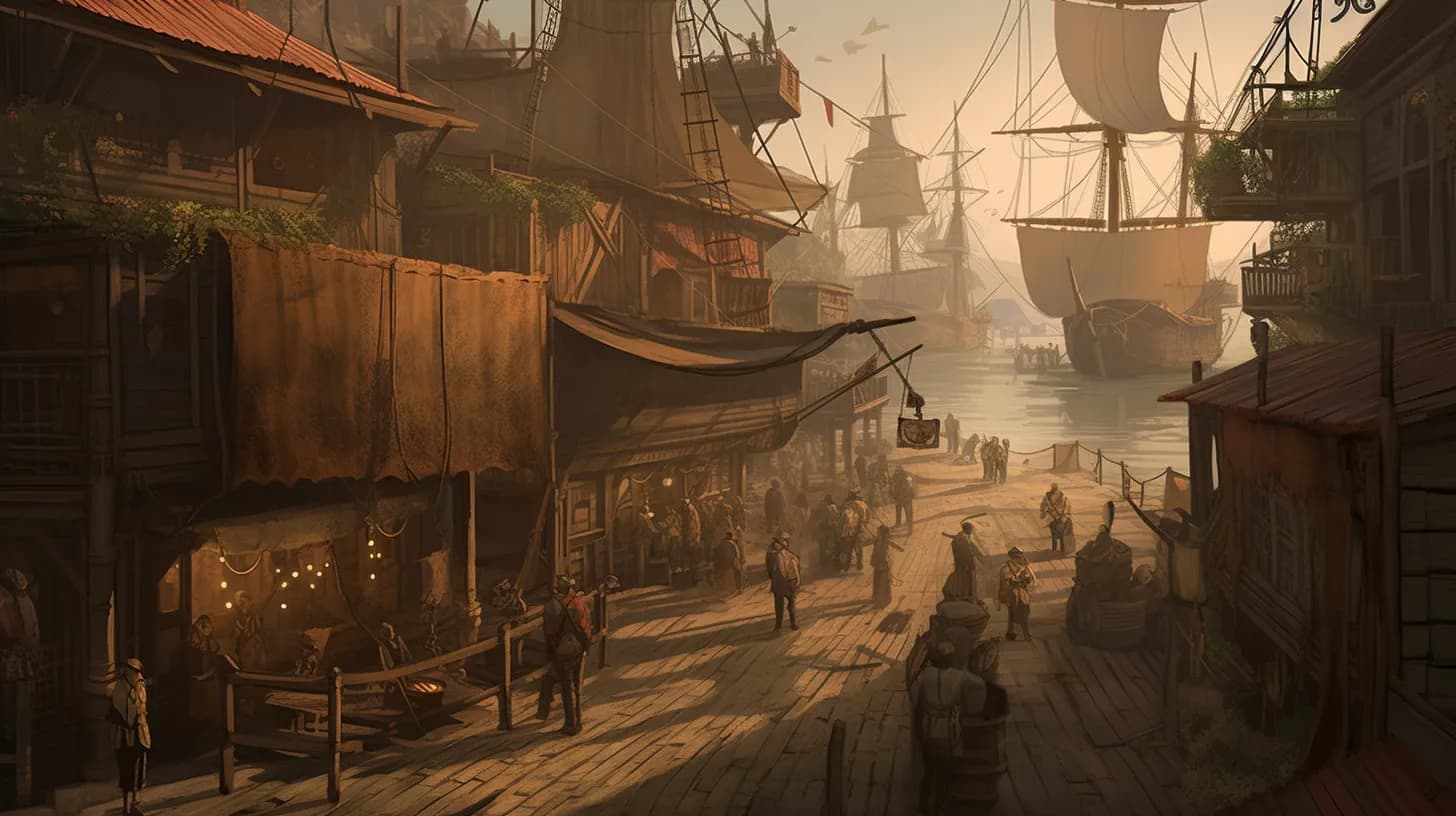
You’ve spent hours crafting your world. Maybe it’s a fog-drenched port city full of hidden passageways and shifting loyalties, or a sun-baked desert with ruins that whisper forgotten magic. You know the layout of the streets, the color of the sky at dusk, and the history behind every symbol etched into ancient stone. You finally get to the session and begin to describe it...
...and someone checks their phone. Another player starts doodling. Eyes glaze over.
If you’ve been there, you’re not alone—and it doesn’t mean your worldbuilding isn’t compelling. What’s happening here isn’t about the quality of your ideas; it’s about the delivery.
Setting the scene should be the moment that draws everyone in. It’s the invitation to step into another world. But too often, that invitation comes across more like a lecture than a story. The difference isn’t in how much effort you put in—it’s in how you present that effort at the table.
The good news? You don’t need to simplify your world. You just need to shift how your players experience it. In this article, we’ll explore small, practical ways to make your descriptions more vivid, more engaging, and more likely to stick. No extra prep required.
What Actually Causes the ‘Info-Dump’ Problem
The root of the problem isn’t that GMs are bad at description—it’s that we care too much.
We front-load. We try to get everything out at once: the history of the town, the political dynamics, the mood, the layout of the streets, the smells from the market, the mysterious figure in the alley... all in one go. Why? Because we’re afraid they’ll miss it. We know how much love we’ve poured into this setting, and we want the players to see all of it right now.
There’s also a subtle pressure to show our work. When we’ve spent hours dreaming up a culture, a city, or a magical system, it feels like a waste not to present it all. But here’s the kicker: dumping everything at once can actually make players less likely to absorb or care about what you’re saying.
It’s not that players don’t appreciate rich settings—they do. But every table has different engagement styles. Some players thrive on vivid imagery, while others are driven by action and goals. If the description doesn’t feel relevant to what they’re trying to do, they tune out—not because they don’t care, but because they don’t know why they should.
So the question becomes: how do you give them context without overloading them?
Small Shifts That Make Descriptions Land Better
You don’t need a total overhaul to fix this. A few subtle adjustments can completely change how your descriptions hit the table.
1. Lead with the Senses
Start with what the characters can immediately perceive: the crunch of gravel underfoot, the sharp tang of metal in the air, the wail of something distant in the wind. Sensory details anchor players in the moment. They create an experience instead of a summary.
Instead of: “You arrive at the city of Durenshal, a massive stone metropolis known for its obsidian spires and thousand-year war with the neighboring empire...”
Try: “The wind cuts through your cloak as you crest the ridge. Below, black towers rise like jagged teeth from the mountain—Durenshal. The air smells of smoke and iron.”
2. Show, Don’t Tell
Describe the effect of the setting, not just the facts. What’s it like to walk through this place? How do people react to it?
Not: “The market is busy and chaotic.”
Try: “A child tugs at your belt pouch before darting into a crowd. A goat bleats from a vendor’s cart. Someone’s shouting about dragonfruit being fresh from the coast—though you’re miles from the sea.”
3. Use Player Perspective
Filter your description through what’s immediately obvious or striking to the party. Think: if a stranger walked into this space, what would grab their attention first?
If your players enter a cathedral, don’t start with the full history of its founding. Start with the echo of their boots on marble. The cold air that smells faintly of incense. Let the world unfold as they explore.
4. One Vivid Detail Beats Five Average Ones
Don’t overwhelm players with a grocery list of attributes. Choose one powerful, memorable image.
“The barkeep has a dozen rings on each hand” is more evocative than “The tavern is dim, smoky, has oak floors, old tables, a bar in the back, and a few patrons.”
Give players something weird, specific, or emotionally charged. That’s what sticks.
5. Pace Your Reveals
Think of descriptions like breadcrumbs. You don’t need to give them the whole loaf at once. Drop key details in response to player actions or choices.
Player: “Can I get a better look at the guard?”
GM: “As you approach, you notice his badge is upside down—deliberately. And there’s a slight tremor in his hand.”
This technique not only avoids overload, but it rewards curiosity and makes exploration feel interactive.
Practicing Without Overhauling Your Prep
Improving your descriptive style doesn’t have to mean rewriting your worldbuilding documents. In fact, you can practice with less prep than you’re doing now.
Ditch Paragraphs — Use Cue Cards
Instead of writing blocks of text, prep 2-3 sensory cues and one character or object detail for each new location. That’s all you need to get started. Let the rest emerge organically.
Practice With Mundane Scenes
Try describing a tavern or a forest path in a way that feels alive. What makes this place different? Is there a drunken bard muttering to himself? Are there ravens watching you a little too intently?
You’ll find your rhythm faster when you’re not trying to force importance onto everything.
Use Player Curiosity as a Trigger
You don’t have to describe everything at once. Instead, describe more when players ask questions, investigate, or show interest.
Player: “What’s behind that statue?”
GM: “A rusted chain disappears into the wall, as if something once hung here. There’s a faint indentation on the floor... like it’s been stepped on recently.”
Descriptions that react to players feel more like a conversation than a performance.
Ask: “What Would a Player Actually Care About?”
Before diving into lore, ask yourself if the information connects to something the players are doing or deciding. If not, save it. You can always weave it in later when it matters.
Wrapping It Up: Less Is More (But Only If It’s Vivid)
At the heart of it, the job of a GM isn’t to transfer all your worldbuilding into your players’ heads. It’s to invite them into a world where their choices shape what they learn and see.
The key shift is this: Stop thinking of setting descriptions as delivery vehicles for facts. Think of them as moments that spark curiosity.
One strange statue, one unsettling sound, one vivid image—these are more powerful than a hundred lines of historical context.
Your players don’t need to know everything at once. They just need enough to want to keep exploring.
So next time you sit down to describe a setting, remember: You’re not giving a lecture. You’re opening a door.
And the best part? You don’t need to say everything—just the right something, at the right time.
TL;DR Summary:
Descriptions fall flat when overloaded with lore or detail.
Start with sensory cues and player-relevant info.
Let the world unfold through play, not monologue.
Focus on vivid, specific moments.
Let curiosity drive discovery.
Let your players feel the world before they understand it—and they’ll keep coming back for more.
About Jessy
Jessy is one of the two creators behind TileForge. He's spent the last 12 years as a dungeon master, TTRPG player, writer, and overall nerd.